Speakers Blythe Semmer and Kelly Fanizzo of the Advisory Council on Historic Preservation (NHPA) deep dove, for me anyways, into Section 106. They touched on its procedures and how it is a stop, look, and listen law, not an if you find this, then you do that protocol. I knew that Section 106 applied to anything that was or could be eligible for protection by NHPA but nothing about how they classified findings or resolved disputes about how to handle the results of such findings.
Remedies I learned that Section 106 is exercised via a four-step process.
1) Does 106 apply
2) If so, identify historic properties
3) Assess for adverse effects that the plan may cause
4) Resolve such effects via changing the plans or other mediation.
It turns out that issues of effect are often handled via an MOA between stakeholders and the company or agency undertaking construction on or near the registered or otherwise protected property. I also learned that all MOAs require a signature from SHPO/THPO and ACHP.
ACHP stands for the Advisory Council on Historic Preservation and consists of a 24 member board appointed by the President, meaning that there is room for them to be affected by changes in Federal leadership. The board always includes a governor, a mayor, a Native American or Hawaiian appointee, and multiple civilians. I was surprised to hear that Hawaiians are included in the mandatory list of members, given the Hawaiian people are not a federally recognized tribe. I lived in Hawaii for five years and saw the multiple issues of their not being recognized has caused for them as a people. I have since learned that despite their non-recognition, the Hawaiians are included in ACHP due to other legislation that has granted them special status. I am happy to hear that their voices are included and wish that other non-recognized tribes did not have to submit individually to be recognized as stakeholders on a case-by-case basis.
The other speaker of the day, prior to the outing, was Erik Hein the Director of the National Conference of State and Historic Preservation Officers (NCSHPO), which is a 501 (c)(3). Like the NHPA mentioned above, there is a lot that goes into what makes up NCSHPO. I found it interesting that as a nonprofit, they help make the process of setting up cell towers near or on Section 106 protected properties more efficient by establishing protocols that are expansive enough to be applied in every state. As for the topic of digitalization of historic resources, it was sadly not surprising to hear him mention that it is still lagging behind need and ad-hoc between states and even counties. Digitalization, I fear, is behind where it should be in all cultural institutions as well.
When he spoke about grants available, he mentioned tax credits, which I have found to be an area of underrated importance. So, he had my attention. Yet, Director Hein seemed confused when I asked where to find the breakdown of how much an hour of volunteerism counts towards any tax credits. I briefly explained that I have experience with an NGO, and the monetary credit that states, counties, and cities receive back for the work hours put in by volunteers is one of the many selling points used for public relations. It helps Team Rubicon get the ask so we can go in and help in disaster areas. I would think that expressing the value of anticipated tax credits would help organizations and stakeholders sell the idea of applying for a grant that requires a 44% match in funds. Not to mention the importance of being able to anticipate the costs of the work they want to undertake. He suggested that I contact the National Park Service. I found him not knowing an important money fact highly odd for someone who works in a continuously underfunded field. But like I said, tax credits are underrated so I guess I shouldn’t have been surprised.
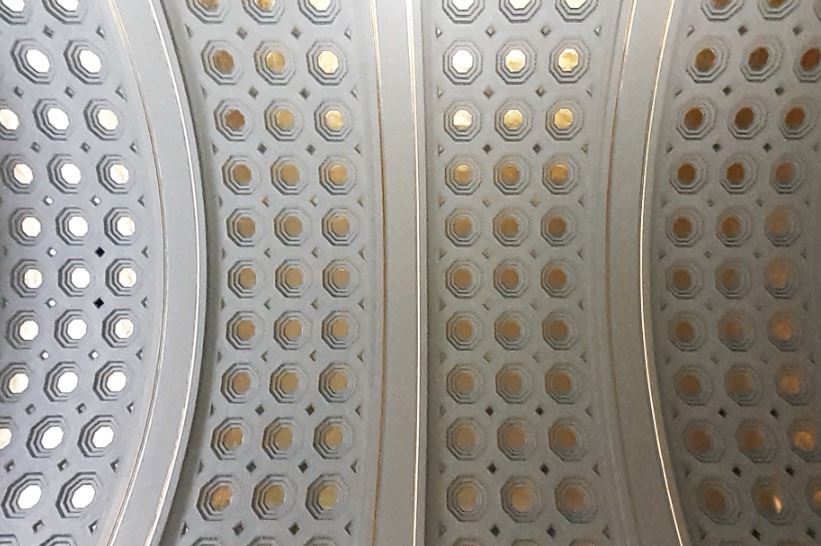
After the three speakers, we ventured out to Union Station, where I think we spent way too much time. It would have been better if we had dedicated at least an hour of that time to our group project work. Don’t get me wrong. Union Station is oddly beautiful in a propagandized display of power sort of way. It is to train stations what Washington giant green bowling lawn was to visitors. It screamed, “I exist because I can.”
The Station is underutilized as a space, and that causes its architecture to feel antiquated and slightly confused. It is shouting to the rooftops its importance while asking, “What am I?” It is a large station with an even larger identity crisis.
The speaker and rest of the day guide local DC Preservationist Emily Eig spoke on the fact that the building is and has been in flux for a while as to its overall purpose outside of being a local train station.
She talked about how after 9-11, they removed numerous chairs from the center gallery due to security concerns. Then went on later to talk about a 2018 proposed plan to place a high-end hotel at one end of the building that would have a large open lounge for guests and travelers alike. She dismissed my concerns about the building still being a soft target and what would security increases be with a “they don’t think that way anymore.”
Who is the “They” she is talking about?
Terrorists, both foreign and domestic, certainly haven’t stopped thinking that way!
I found her hand-waving dismissiveness of my concern insulting to the 186 people killed in the Oklahoma City Bombing, the near 3,000 killed on 9-11, of which 2,763 were at the World Trade Center, and to the victims of the 2013 Boston Marathon Bombing.
I walked over to a fellow Veteran in the class, and he just looked at me and said, “What’s stopping the next 9-11? Nothing, they’ve really done nothing.” Another student, with no military affiliation, later confided in me that their first thought was, “Thank god she didn’t get to make those decisions,” and that they quit listening to her after her comment because “she didn’t know what she was talking about.”
People with her attitude are why people are dead and why more will die.
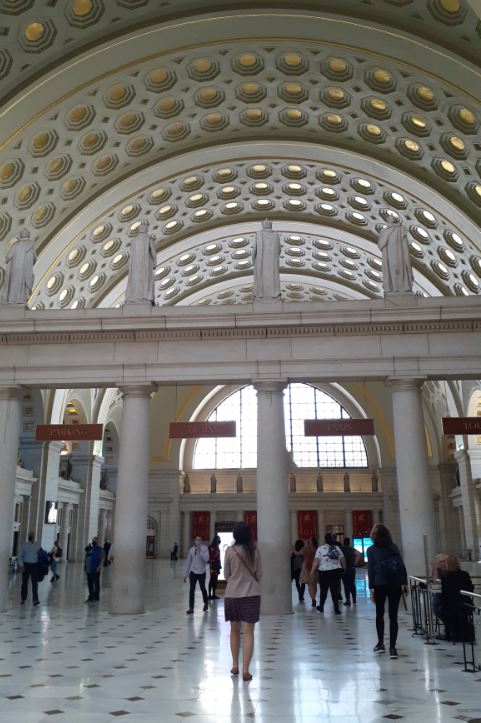
I do hope that the building gains a cohesive identity. I also hope that as it does, it also gets better security. If it becomes both a tourist destination and hub of transportation, it will need it even more than it does now. It will be an iconic place that is perfect for those with poison in their hearts to carry out a mass casualty incident.
I know that as a future museum professional my concerns might read as paranoid or off-topic. But if they were either of those things then why do books on best practices for museums include chapters on how to handle active shooter situations and other threats to visitor safety like terrorist attacks?
 Museum Studies & Cultural Heritage