
Every class starts with speakers and today was no exception. Dr. Ruth Trocolli, the Archaeologist for DC, spoke about the unique issues of performing research in a densely packed urban space where federal laws often intersect with what would elsewhere in the country be considered a state-level interest. I found it odd how DC’s lack of statehood did not prevent it from receiving types of aid reserved for states. I also learned of the Younger Dryas period that increased the difficulty of performing archeological digs in the district. The continuous learning aspect that accompanies museum work was one of the many things that made it attractive to me as a career field. So if a speaker wants to throw in some new information during the talk: Yes, Please? Like other speakers, it is noteworthy how much Dr. Trocolli does with such little support.
Dr. Michelle Stefano, a Folklife Specialist in Research and Programs at the American Folklife Center at the Library of Congress, talked about supporting intangible heritage and its related collection delt in part with one of my most significant concerns as a future museum professional. What are the best practices to ensure that agency is not taken from the people to whom the culture and its objects belong? This concern comes in part from the artifice that accompanies all things when they become partially or fully displaced from their origin by the act of exhibition and more significantly from the residue of past colonialist collecting practices that othered the source cultures, which still coats many collections. Dr. Stefano gave intelligent responses to those issues by talking about how they try to get back to the source or a descendent before moving ahead to the next step of the planning process.
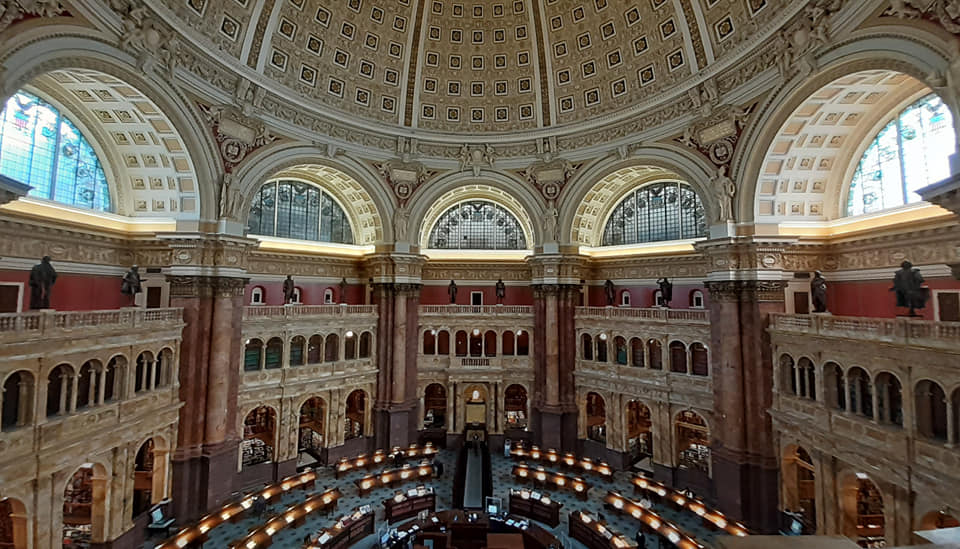
After the speakers, we headed over to the Library of Congress, where quite frankly, I did not know what to expect aside from being impressed. I was not let down and now have a multitude of questions.
- Were the frescos painted on dry or wet plaster?
- What is the allegorical meaning of the cherubs holding a cup and a scissor in the overlook to the reading room?
- How do you care for spot problems in the plaster?
- Who chose the phrases over the doors and under the windows?
- Why is only the lower floor’s ceiling covered in a mosaic?
- Was it by design?
- Does it have to do with the structural weight load, or was it an aesthetic choice?
- What is the cleaning and care regime like for the collection, given its enormity?
- How much of the library is currently digitized?
- How much is on display?
- Who came up with the minimalist floating mount for the Gutenberg Bible?
- Was it placed near the listing of Milton’s name on the ceiling on purpose, or was that a happy accident?
- Was the pink pattern motif in the Rosa Park’s exhibit related directly to her in someway or was it just an asethic choice made by the curator?
- How do they handle the disscusion about certain names emblazoned on the walls about whom public opinions have changed to the negative?
I could go on and on.

 Museum Studies & Cultural Heritage